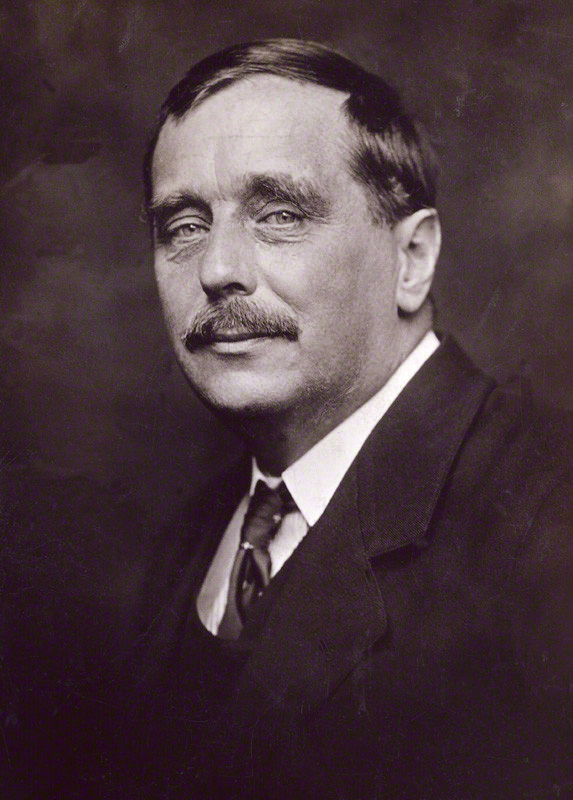
Herbert George Wells słynne cytaty
The weaving of mankind into one community does not imply the creation of a homogeneous community, but rather the reverse; the welcome and adequate utilization of distinctive quality in an atmosphere of understanding… Communities all to one pattern, like boxes of toy soldiers, are things of the past, rather than of the future. (ang.)
Źródło: Historia świata (1920)
At the mouth of the Vistula stood the entirely German city of Danzig. It lived mainly as an outlet for Polish trade, and it could prosper in no other way. There was no reason to suppose it would put any difficulties in the way of Polish imports and exports. It was an ancient, honest, clean and prosperous German city. Ninety-six per cent of its inhabitants were German. (…) But they separated it from Germany and made it into a "free city", and to the west of it they achieved that "access to the sea" of Wilson’s, by annexing a broad band of Pomeranian territory to Poland. (ang.) <br class="br">Źródło: The Shape of Things to Come, 1933 http://ebooks.adelaide.edu.au/w/wells/hg/w45th/book1.html#chapter10
„Zbyt łatwe osiągnięcia nie wzbudzają ufności.”
Herbert George Wells książka Wehikuł czasu
Wehikuł czasu
Herbert George Wells cytaty
„W naszym świecie ludzie bogacą się raczej ujmując innym niż służąc.”
Źródło: Wielka księga mądrości, wybór Jacek i Tomasz Ilga
„Nie ma gorszych ślepców nad tych, którzy nie chcą widzieć.”
Źródło: Danuta Gorajewska, Fakty i mity o osobach z niepełnosprawnością, Stowarzyszenie Przyjaciół Integracji, Warszawa 2006.
The indignity and menace of Danzig burnt into the German imagination. That Corridor fretted it as nothing else in the peace settlement had fretted it. (…)<br>Within a dozen years of the signing of the Treaty of Versailles the Polish Corridor was plainly the most dangerous factor in the European situation. It mocked every projection of disarmament. It pointed the hypnotized and impotent statescraft of Europe straight towards a resumption of war. (ang.) <br class="br">fragment opubl. w 1933 dzieła Kształt rzeczy przyszłych w którym autor po raz pierwszy używa w stosunku do polskiego Pomorza sformułowania „Korytarz polski” szeroko później wykorzystywanego przez Josepha Goebbelsa. <br class="br">Źródło: The Shape of Things to Come, 1933 http://ebooks.adelaide.edu.au/w/wells/hg/w45th/book1.html#chapter10
Herbert George Wells: Cytaty po angielsku
H. G. Wells książka The Island of Doctor Moreau
Źródło: The Island of Doctor Moreau (1896), Ch. 16: How the Beast Folk Tasted Blood
“The Boss: You are not mechanics, you are warriors. You have been trained, not to think, but to do.”
H. G. Wells książka The Shape of Things to Come
Things to Come (1936)
“How small the vastest of human catastrophes may seem at a distance of a few million miles.”
H. G. Wells The Star
"The Star", final line, first published in The Graphic, Christmas issue (1897)
H. G. Wells książka The Outline of History
Źródło: The Outline of History (1920), Ch. 41
“Our true nationality is mankind.”
H. G. Wells książka The Outline of History
Źródło: The Outline of History (1920), Ch. 41
“For crude classifications and false generalisations are the curse of all organised human life.”
H. G. Wells książka A Modern Utopia
Źródło: A Modern Utopia (1905), Ch. 10, sect. 1
H. G. Wells książka The Shape of Things to Come
Things to Come (1936)
H. G. Wells książka The Future in America: A Search After Realities
The Future in America (1906)
H. G. Wells książka The Invisible Man
Źródło: The Invisible Man (1897), Chapter 23: In Drury Lane
H. G. Wells książka The Shape of Things to Come
Things to Come (1936)
H. G. Wells książka The Island of Doctor Moreau
Źródło: The Island of Doctor Moreau (1896), Ch. 14: Doctor Moreau Explains
H. G. Wells książka The World Set Free
The World Set Free
“Rowena: You’ve got the subtlety of a bullfrog.”
H. G. Wells książka The Shape of Things to Come
Things to Come (1936)
“I had rather be called a journalist than an artist.”
Letter to author Henry James (8 July 1915)
H. G. Wells książka A Modern Utopia
Źródło: A Modern Utopia (1905), Ch. 10, sect. 3
H. G. Wells książka The Invisible Man
Źródło: The Invisible Man (1897), Chapter 20: At the House In Great Portland Street
"What I Believe", The Listener, 1929. Quoted in Clifton Fadiman, I Believe, London, George Allen and Unwin, 1940.
H. G. Wells książka Anticipations
Anticipations (1902)
H. G. Wells książka The New World Order
The New World Order (1939)
The Rights of Man, or what are we fighting for? (1940)
“If you fell down yesterday, stand up today.”
The Anatomy of Frustration (1936)
“The uglier a man's legs are, the better he plays golf. It's almost a law.”
H. G. Wells książka Bealby
Bealby: A Holiday (1915)
H. G. Wells książka The Invisible Man
Źródło: The Invisible Man (1897), Chapter 21: In Oxford Street
H. G. Wells książka The Outline of History
Źródło: The Outline of History (1920), Ch. 40
H. G. Wells książka The Island of Doctor Moreau
Źródło: The Island of Doctor Moreau (1896), Ch. 21: The Reversion of the Beast Folk
“An artist who theorizes about his work is no longer artist but critic.”
The Temptaion of Harringay (1929)
H. G. Wells książka The War of the Worlds
Book I, Ch. 7: How I Reached Home
The War of the Worlds (1898)
“Adapt or perish, now as ever, is Nature's inexorable imperative.”
The Mind at the End of its Tether (1945), p. 19


