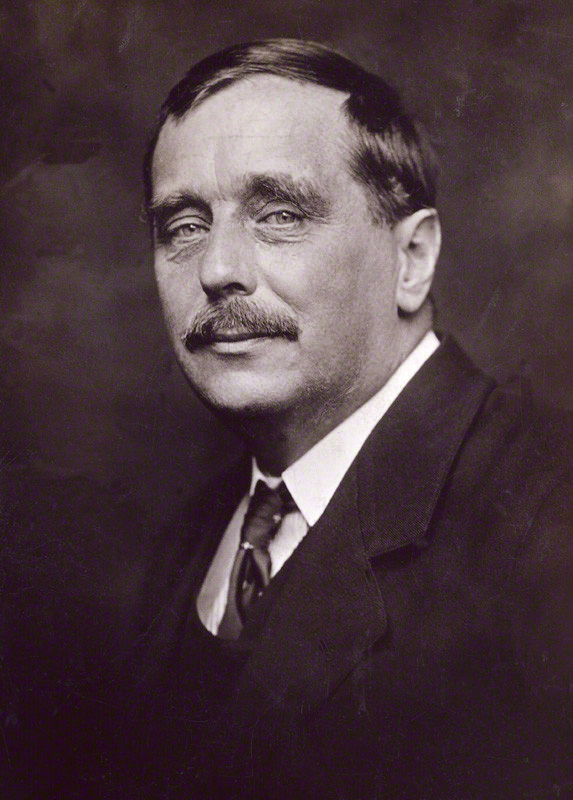
Herbert George Wells słynne cytaty
The weaving of mankind into one community does not imply the creation of a homogeneous community, but rather the reverse; the welcome and adequate utilization of distinctive quality in an atmosphere of understanding… Communities all to one pattern, like boxes of toy soldiers, are things of the past, rather than of the future. (ang.)
Źródło: Historia świata (1920)
At the mouth of the Vistula stood the entirely German city of Danzig. It lived mainly as an outlet for Polish trade, and it could prosper in no other way. There was no reason to suppose it would put any difficulties in the way of Polish imports and exports. It was an ancient, honest, clean and prosperous German city. Ninety-six per cent of its inhabitants were German. (…) But they separated it from Germany and made it into a "free city", and to the west of it they achieved that "access to the sea" of Wilson’s, by annexing a broad band of Pomeranian territory to Poland. (ang.) <br class="br">Źródło: The Shape of Things to Come, 1933 http://ebooks.adelaide.edu.au/w/wells/hg/w45th/book1.html#chapter10
„Zbyt łatwe osiągnięcia nie wzbudzają ufności.”
Herbert George Wells książka Wehikuł czasu
Wehikuł czasu
Herbert George Wells cytaty
„W naszym świecie ludzie bogacą się raczej ujmując innym niż służąc.”
Źródło: Wielka księga mądrości, wybór Jacek i Tomasz Ilga
„Nie ma gorszych ślepców nad tych, którzy nie chcą widzieć.”
Źródło: Danuta Gorajewska, Fakty i mity o osobach z niepełnosprawnością, Stowarzyszenie Przyjaciół Integracji, Warszawa 2006.
The indignity and menace of Danzig burnt into the German imagination. That Corridor fretted it as nothing else in the peace settlement had fretted it. (…)<br>Within a dozen years of the signing of the Treaty of Versailles the Polish Corridor was plainly the most dangerous factor in the European situation. It mocked every projection of disarmament. It pointed the hypnotized and impotent statescraft of Europe straight towards a resumption of war. (ang.) <br class="br">fragment opubl. w 1933 dzieła Kształt rzeczy przyszłych w którym autor po raz pierwszy używa w stosunku do polskiego Pomorza sformułowania „Korytarz polski” szeroko później wykorzystywanego przez Josepha Goebbelsa. <br class="br">Źródło: The Shape of Things to Come, 1933 http://ebooks.adelaide.edu.au/w/wells/hg/w45th/book1.html#chapter10
Herbert George Wells: Cytaty po angielsku
H. G. Wells książka The First Men in the Moon
Źródło: The First Men in the Moon (1901), Ch. 19: Mr. Bedford Alone
The Rights of Man, or what are we fighting for? (1940)
H. G. Wells książka The Invisible Man
Źródło: The Invisible Man (1897), Chapter 6: The Furniture that Went Mad
“Marguerite, joyfully: “We are ourselves, my dear, we are ourselves. Well never be anyone else.””
The New Faust https://www.google.com/search?client=ubuntu&channel=fs&q=%22We+are+ourselves%2C+we+are+ourselves%2C+and+we%27ll+never+be+anyone+else.%22&ie=utf-8&oe=utf-8#channel=fs&q=Marguerite%2C+joyfully:+%E2%80%9CWe+are+ourselves%2C+my+dear%2C+we+are+ourselves.+We%27 (in Nash's Pall Magazine, December 1936 – adaptation of "The Story of the Late Mr. Elvesham")
“Cynicism is humour in ill health.”
H. G. Wells książka Boon
Boon, The Mind of the Race, The Wild Asses of the Devil, and The Last Trump (1915)
H. G. Wells książka The Shape of Things to Come
Things to Come (1936)
H. G. Wells książka The War of the Worlds
Book II, Ch. 8 (Ch. 25 in editions without Book divisions): Dead London
The War of the Worlds (1898)
H. G. Wells książka The Discovery of the Future
The Discovery of the Future (1901)
The Rights of the World Citizen (1942); a revised edition of The Rights of Man
“One of the darkest evils of our world is surely the unteachable wildness of the Good.”
H. G. Wells książka A Modern Utopia
Źródło: A Modern Utopia (1905), Ch. 2, sect. 6
H. G. Wells książka The Island of Doctor Moreau
Źródło: The Island of Doctor Moreau (1896), Ch. 15: Concerning the Beast Folk
The Rights of Man, or what are we fighting for? (1940)
What is Coming? (1916)
H. G. Wells książka The Invisible Man
Źródło: The Invisible Man (1897), Chapter 27: The Seige of Kemp's House
H. G. Wells książka The Outline of History
Źródło: The Outline of History (1920), Ch. 40
H. G. Wells książka A Modern Utopia
Źródło: A Modern Utopia (1905), Ch. 3, sect. 8
H. G. Wells książka The Outline of History
The Outline of History (1920)
Attributed to Wells's book New Worlds for Old (1908) by Ferdinand Lundberg in Scoundrels All (1968), p. 126. The quote is widely repeated on the internet, but does not appear in the cited work.
Misattributed
Źródło: First and Last Things: A Confession of Faith and Rule of Life http://www.gutenberg.org/etext/4225 (1908), Ch.3, section 20, Of Abstinences and Disciplines
1935 speech at Barber's Hall, London, included in Round the World for Birth Control (1937) edited by the Birth Control International Information Centre
H. G. Wells książka The Invisible Man
Źródło: The Invisible Man (1897), Chapter 23: In Drury Lane
H. G. Wells książka A Modern Utopia
Źródło: A Modern Utopia (1905), Ch. 3, sect. 3
H. G. Wells książka A Modern Utopia
Źródło: A Modern Utopia (1905), Ch. 1, sect. 5
H. G. Wells książka The Invisible Man
Źródło: The Invisible Man (1897), Chapter 9: Mr. Thomas Marvel
“The crisis of yesterday is the joke of to-morrow.”
You Can't be Too Careful (1941)
H. G. Wells książka Love and Mr Lewisham
Love and Mr Lewisham (1899), Ch. 23
H. G. Wells książka A Modern Utopia
Źródło: A Modern Utopia (1905), Ch. 9, sect. 5


