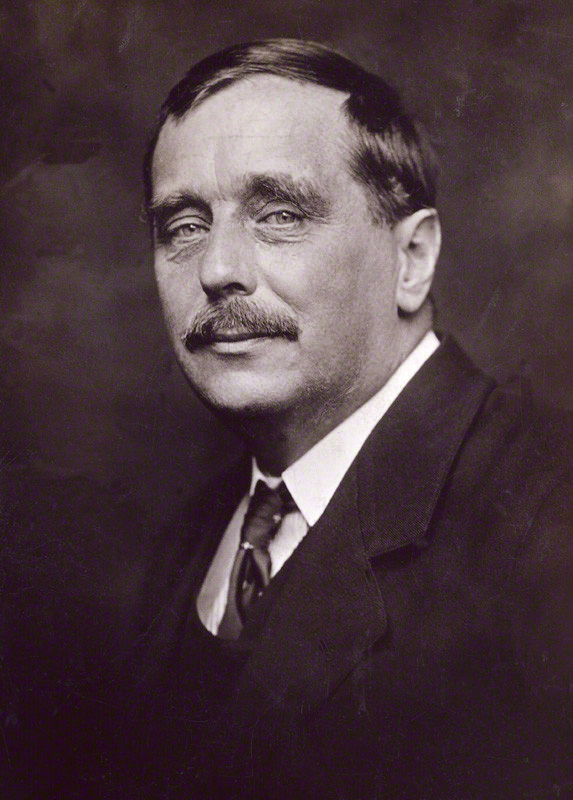
Herbert George Wells słynne cytaty
The weaving of mankind into one community does not imply the creation of a homogeneous community, but rather the reverse; the welcome and adequate utilization of distinctive quality in an atmosphere of understanding… Communities all to one pattern, like boxes of toy soldiers, are things of the past, rather than of the future. (ang.)
Źródło: Historia świata (1920)
At the mouth of the Vistula stood the entirely German city of Danzig. It lived mainly as an outlet for Polish trade, and it could prosper in no other way. There was no reason to suppose it would put any difficulties in the way of Polish imports and exports. It was an ancient, honest, clean and prosperous German city. Ninety-six per cent of its inhabitants were German. (…) But they separated it from Germany and made it into a "free city", and to the west of it they achieved that "access to the sea" of Wilson’s, by annexing a broad band of Pomeranian territory to Poland. (ang.) <br class="br">Źródło: The Shape of Things to Come, 1933 http://ebooks.adelaide.edu.au/w/wells/hg/w45th/book1.html#chapter10
„Zbyt łatwe osiągnięcia nie wzbudzają ufności.”
Herbert George Wells książka Wehikuł czasu
Wehikuł czasu
Herbert George Wells cytaty
„W naszym świecie ludzie bogacą się raczej ujmując innym niż służąc.”
Źródło: Wielka księga mądrości, wybór Jacek i Tomasz Ilga
„Nie ma gorszych ślepców nad tych, którzy nie chcą widzieć.”
Źródło: Danuta Gorajewska, Fakty i mity o osobach z niepełnosprawnością, Stowarzyszenie Przyjaciół Integracji, Warszawa 2006.
The indignity and menace of Danzig burnt into the German imagination. That Corridor fretted it as nothing else in the peace settlement had fretted it. (…)<br>Within a dozen years of the signing of the Treaty of Versailles the Polish Corridor was plainly the most dangerous factor in the European situation. It mocked every projection of disarmament. It pointed the hypnotized and impotent statescraft of Europe straight towards a resumption of war. (ang.) <br class="br">fragment opubl. w 1933 dzieła Kształt rzeczy przyszłych w którym autor po raz pierwszy używa w stosunku do polskiego Pomorza sformułowania „Korytarz polski” szeroko później wykorzystywanego przez Josepha Goebbelsa. <br class="br">Źródło: The Shape of Things to Come, 1933 http://ebooks.adelaide.edu.au/w/wells/hg/w45th/book1.html#chapter10
Herbert George Wells: Cytaty po angielsku
H. G. Wells książka The Shape of Things to Come
Things to Come (1936)
H. G. Wells książka The Open Conspiracy
The Open Conspiracy (1928)
The Informative Content of Education http://books.google.com/books?&id=vLs4AAAAMAAJ&q=%22I+believe+that+the+crazy+combative+patriotism+that+plainly+threatens+to+destroy+civilisation+to-day+is+very+largely+begotten+by+the+schoolmaster+and+the+schoolmistress+in+their+history+lessons+They+take+the+growing+mind+at+a+naturally+barbaric+phase+and+they+inflame+and+fix+its+barbarism%22&pg=PA242#v=onepage Speech http://archive.org/stream/reportofbritisha37adva#page/242/mode/2up given at the annual meeting of the British Association for the Advancement of Science in Nottingham, England on 2 September 1937
H. G. Wells książka The Outline of History
The Outline of History (1920)
H. G. Wells książka The War in the Air
The War in the Air (1907), Ch. VIII, §1
H. G. Wells książka The First Men in the Moon
Źródło: The First Men in the Moon (1901), Ch. 13: Mr. Cavor Makes Some Suggestions
H. G. Wells książka The Invisible Man
Źródło: The Invisible Man (1897), Chapter 10: Mr. Marvel's Visit To Iping
H. G. Wells książka The Island of Doctor Moreau
Źródło: The Island of Doctor Moreau (1896), Ch. 14: Doctor Moreau Explains
“Humanity either makes, or breeds, or tolerates all its afflictions, great or small.”
H. G. Wells książka Joan and Peter
Joan and Peter: The Story of an Education (1918)
“Human history is in essence a history of ideas.”
H. G. Wells książka The Outline of History
Źródło: The Outline of History (1920), Ch. 40
“An animal may be ferocious and cunning enough, but it takes a real man to tell a lie.”
H. G. Wells książka The Island of Doctor Moreau
Źródło: The Island of Doctor Moreau (1896), Ch. 21: The Reversion of the Beast Folk
“I was never a great amorist, though I have loved several people very deeply.”
An Experiment in Autobiography http://gutenberg.ca/ebooks/wellshg-autobiography/wellshg-autobiography-00-h-dir/wellshg-autobiography-00-h.html (1934)
The Work, Wealth and Happiness of Mankind, Ch. 11 (1931)
H. G. Wells książka Zoological Retrogression
Zoological Retrogression (1891)
H. G. Wells książka The Island of Doctor Moreau
Źródło: The Island of Doctor Moreau (1896), Ch. 14: Doctor Moreau Explains
“For adaptations based on the novel see The War of the Worlds (disambiguation).”
H. G. Wells książka The War of the Worlds
The War of the Worlds (1898)
H. G. Wells książka The Island of Doctor Moreau
Źródło: The Island of Doctor Moreau (1896), Ch. 17: A Catastrophe
H. G. Wells książka The Island of Doctor Moreau
Źródło: The Island of Doctor Moreau (1896), Ch. 16: How the Beast Folk Tasted Blood
H. G. Wells książka The Island of Doctor Moreau
Źródło: The Island of Doctor Moreau (1896), Ch. 22: The Man Alone
“Stalin-Wells Talk: The Verbatim Report and A Discussion”, G.B. Shaw, J.M. Keynes et al., London, The New Statesman and Nation, (1934) p. 15
“Stalin-Wells Talk: The Verbatim Report and A Discussion”, G.B. Shaw, J.M. Keynes et al., London, The New Statesman and Nation, (1934) p. 19


