„Przebaczaj swoim wrogom, ale nigdy nie zapominaj ich nazwisk.”
Źródło: Wielka księga mądrości, wybór Jacek i Tomasz Ilga
John Fitzgerald Kennedy, „JFK”, „Jack Kennedy”, „Ken” – amerykański polityk, 35. prezydent Stanów Zjednoczonych, zginął w zamachu.
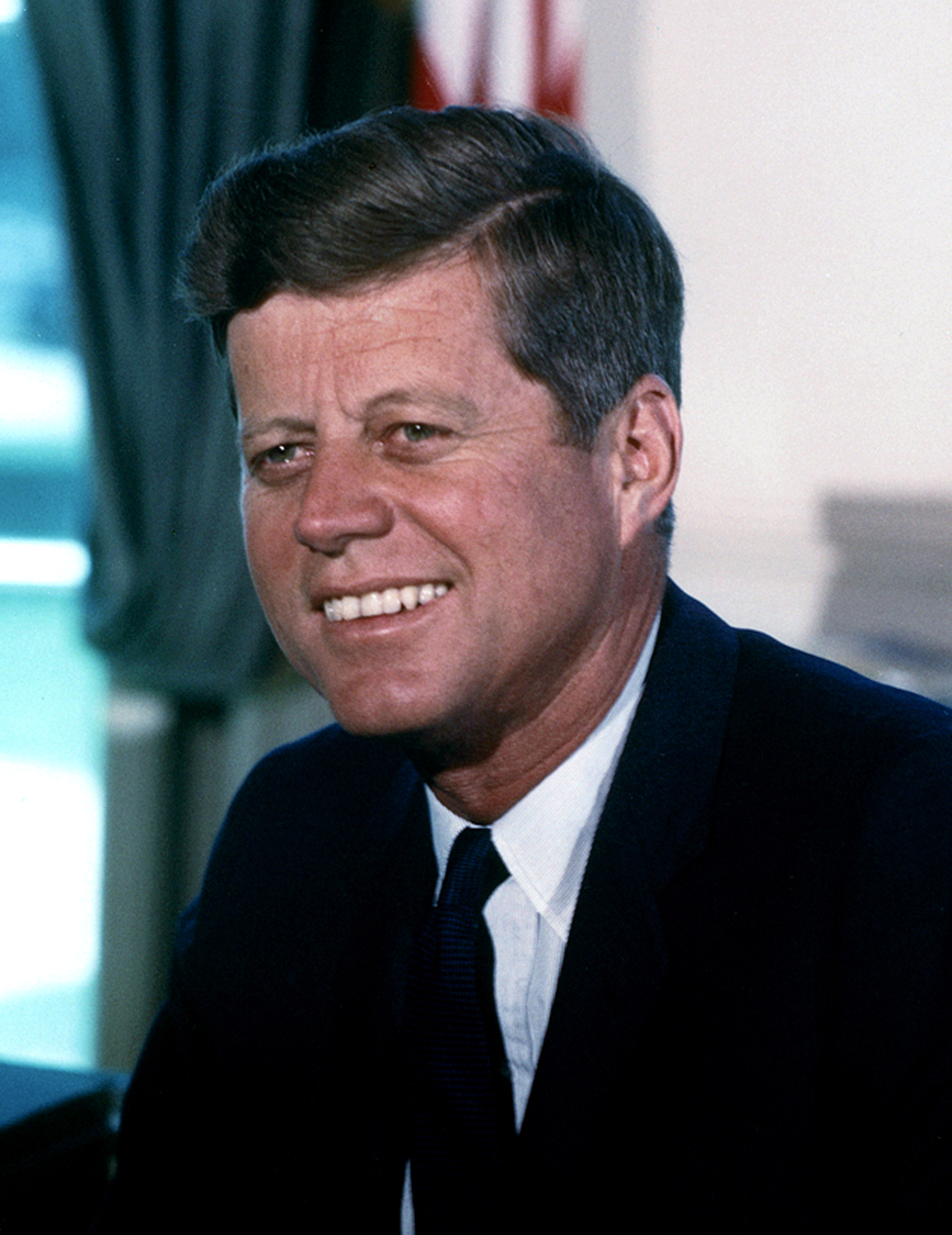
„Przebaczaj swoim wrogom, ale nigdy nie zapominaj ich nazwisk.”
Źródło: Wielka księga mądrości, wybór Jacek i Tomasz Ilga
Źródło: National Archives and Records Administration, cyt. za: Oliver Stone’s Untold History of the United States (2012), tłum. Anna Rajca, Mirosław Filipowicz, odcinek 6
„Nie pytajcie, co kraj może zrobić dla was; pytajcie, co wy możecie zrobić dla kraju.”
Inne tłumaczenie: Nie pytajmy, co może zrobić dla nas ojczyzna. Pytajmy, co my możemy dla niej uczynić.
And so, my fellow Americans: ask not what your country can do for you – ask what you can do for your country. (ang.)
przemówienie inauguracyjne, 20 stycznia 1961
„Nasze problemy zostały stworzone przez ludzi i mogą zostać przez ludzi rozwiązane.”
Our problems are manmade – therefore, they can be solved by man. (ang.)
przemówienie na The American University, Waszyngton, 10 czerwca 1963
25 maja 1961.
Źródło: Gerard Degroot, Byle nie wyorbitować, „The Daily Telegraph”, tłum. „Forum”, 11 kwietnia 2011.
John Fitzgerald Kennedy książka Ich bin ein Berliner
Ich bin ein Berliner. (niem.)
przemówienie skierowane przeciw ZSRR (budowa muru berlińskiego)
na tajnej naradzie w NASA zwołanej tuż po udanym locie orbitalnym Jurija Gagarina w kwietniu 1961.
Źródło: Gerard Degroot, Byle nie wyorbitować, „The Daily Telegraph”, tłum. „Forum”, 11 kwietnia 2011.
przemówienie z czerwca 1963, wygłoszone przed podpisaniem układu ze Związkiem Radzieckim o ograniczeniu prób nuklearnych.
Źródło: Oliver Stone’s Untold History of the United States (2012), tłum. Anna Rajca, Mirosław Filipowicz, odcinek 6
po zakończonej klęską próbie inwazji na Kubę.
Źródło: Oliver Stone’s Untold History of the United States (2012), tłum. Anna Rajca, Mirosław Filipowicz, odcinek 6
Źródło: Gerard Degroot, Byle nie wyorbitować, „The Daily Telegraph”, tłum. „Forum”, 11 kwietnia 2011.
fragment przemówienia.
Źródło: Oliver Stone’s Untold History of the United States (2012), tłum. Anna Rajca, Mirosław Filipowicz, odcinek 6
Źródło: przemówienie inauguracyjne, 20 stycznia 1961 http://avalon.law.yale.edu/20th_century/kennedy.asp; cyt. za: Avalon Project – Documents in Law, History and Diplomacy, Yale Law School Lillian Goldman Law Library.
All my life I’ve known better than to depend on the experts. How could I have been so stupid, to let them go ahead? (ang.)
po inwazji w Zatoce Świń.
Źródło: Theodore C. Sorensen, Kennedy, 1965
We choose to go to the moon in this decade and do the other things, not because they are easy, but because they are hard, because that goal will serve to organize and measure the best of our energies and skills (…).
przemówienie na Rice University, Houston, 12 września 1962.
gdy spytano go, dlaczego lot na Księżyc jest taki istotny.
Źródło: Gerard Degroot, Byle nie wyorbitować, „The Daily Telegraph”, tłum. „Forum”, 11 kwietnia 2011.
„Mur jest najbardziej oczywistą i widoczną demonstracją fiaska systemu komunistycznego.”
przemówienie skierowane przeciw ZSRR (budowa muru berlińskiego)
1963, Remarks Prepared for Delivery at the Trade Mart in Dallas
John F. Kennedy książka Ich bin ein Berliner
1963, Ich bin ein Berliner
First State of the Union Address (30 January 1961)
1961, State of the Union
“We celebrate the past to awaken the future.”
"Remarks at the 25th Anniversary of the Signing of the Social Security Act," Hyde Park, New York (14 August 1960) http://www.jfklibrary.org/Research/Research-Aids/Ready-Reference/JFK-Quotations.aspx; Box 910, Senate Speech Files, John F. Kennedy Papers, Pre-Presidential Papers, John F. Kennedy Presidential Library <br class="br">1960
Źródło: 1961, Speech to Special Joint Session of Congress
1961, Address before the American Society of Newspaper Editors
1963, Address at Vanderbilt University
1963, American University speech
“Certain other societies may respect the rule of force — we respect the rule of law.”
1963, Address at Vanderbilt University
Kennedy here references Francis Bacon’s Aphorism 129 of Novum Organum: Again, we should notice the force, effect, and consequences of inventions, which are nowhere more conspicuous than in those three which were unknown to the ancients; namely, printing, gunpowder, and the compass. For these three have changed the appearance and state of the whole world; first in literature, then in warfare, and lastly in navigation: and innumerable changes have been thence derived, so that no empire, sect, or star, appears to have exercised a greater power and influence on human affairs than these mechanical discoveries.
1961, Address to ANPA
Acceptance speech (9 November 1960) http://www.jfklibrary.org/Research/Ready-Reference/JFK-Speeches/Acceptance-Speech-by-John-F-Kennedy-Hyannis-Armory-Hyannis-Massachusetts-November-9-1960.aspx <br class="br">1960
“Somebody once said that Washington was a city of Northern charm and Southern efficiency.”
Speech http://www.jfklibrary.org/Asset-Viewer/Archives/JFKPOF-036-014.aspx to the Trustees and Advisory Committee of the National Cultural Center in the White House Movie Theater, 14 November 1961 <br class="br">1961
Speech at Civic Auditorium, Seattle, Washington (6 September 1960)
1960
“We must first bring others to see their own true interests better than they do today.”
1963, Address at the Free University of Berlin
“Things don't just happen, they are made to happen.”
Speech given at the Arkansas State Fairground, Little Rock, United States of America (3 October 1963); quoted in John F. Kennedy in Quotations: A Topical Dictionary, with Sources (2013), McFarland, entry 1729
1963
1961, Address to ANPA
Radio and Television Report to the Nation on the Situation at the University of Mississippi (30 September 1962)
1962
Message to Chairman Khrushchev Concerning the Meaning of Events in Cuba (18 April 1961).
1961
1962, Second Letter to Nikita Khrushchev
Speech at Civic Auditorium, Seattle, Washington (6 September 1960)
1960
1963, Address at the Free University of Berlin
Remarks at Amherst College (26 October 1963)
1963
[http://www.jfklibrary.org/Research/Research-Aids/Ready-Reference/JFK-Quotations.aspx "President's News Conference (107)" (21 March 1962)
1962
1960, Speech to the Greater Houston Ministerial Association
Undated Letter to a Navy friend http://www.jfklibrary.org/Research/Ready-Reference/JFK-Quotations.aspx; also mentioned by William Safire in his "On Language" article "Warrior" in the New York Times rubric Magazines (26 August 2007) http://www.nytimes.com/2007/08/26/magazine/26wwln-safire-t.html; also in A Thousand Days : John F. Kennedy in the White House (1965), by Arthur Schlesinger, p. 88 http://www.jfklibrary.org/Research/Research-Aids/Ready-Reference/JFK-Quotations.aspx <br class="br">Pre-1960
"Letter to the United States Army" (11 April 1962) http://www.jfklibrary.org/Research/Research-Aids/Ready-Reference/JFK-Quotations.aspx; Box 5, President's Outgoing Executive Correspondence, White House Central Chronological Files, Papers of John F. Kennedy, John F. Kennedy Presidential Library <br class="br">1962
Comments on members of the Republican party, in Remarks at the Cow Palace, San Francisco, California (2 November 1960) http://www.jfklibrary.org/Research/Research-Aids/Ready-Reference/JFK-Quotations.aspx; Box 914, Senate Speech Files, John F. Kennedy Papers, Pre-Presidential Papers, John F. Kennedy Presidential Library <br class="br">1960
1963, American University speech
“It's only when they join together in a forward movement that this country moves ahead…”
"Remarks at Los Banos, CA at the Groundbreaking Ceremonies for the San Luis Dam (337)" (18 August 1962) http://www.jfklibrary.org/Research/Research-Aids/Ready-Reference/JFK-Quotations.aspx <br class="br">1962
1961, Address at the University of Washington


