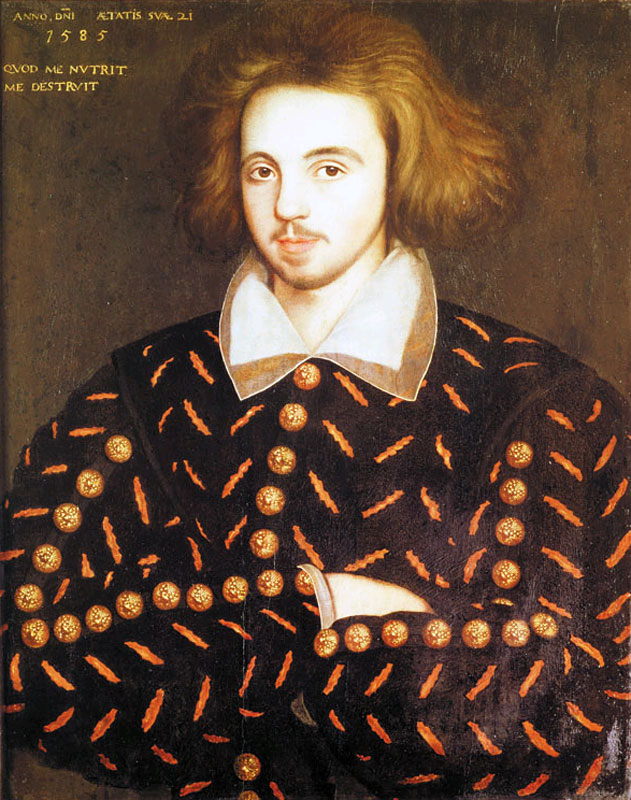
Christopher Marlowe: 61 cytatów1 Polubienie
Christopher Marlowe słynne cytaty
Christopher Marlowe Tamerlan Wielki
Źródło: Tamerlan Wielki
„Kto kiedy kochał, nie kochał od pierwszego wejrzenia?”
Christopher Marlowe książka Hero and Leander
Who ever lov'd, that lov'd not at first sight? (ang.)
Źródło: Hero and Leander
Tragiczne dzieje doktora Fausta
Christopher Marlowe: Cytaty po angielsku
“Pray for me! and what noise soever ye hear, come not unto me, for nothing can rescue me.”
Christopher Marlowe The Tragical History of Doctor Faustus
Faustus, Act V, scene ii, lines 57–58
Doctor Faustus (c. 1603)
“What strange arts necessity finds out.”
Venus, Act I, scene i, line 169
Dido (c. 1586)
“My men, like satyrs grazing on the lawns,
Shall with their goat feet dance the antic hay.”
Gaveston, Act I, scene i, lines 57–58
Edward II (c. 1592)
“I'm armed with more than complete steel,—
The justice of my quarrel.”
Lust's Dominion (c. 1600), Act iii. scene 4. Compare: "Thrice is he armed that hath his quarrel just, And he but naked, though locked up in steel, Whose conscience with injustice is corrupted", William Shakespeare, Henry VI, Act iii. scene 2.
Misattributed
“Religion
Hides many mischiefs from suspicion.”
Christopher Marlowe The Jew of Malta
Barabas, Act I, scene ii
The Jew of Malta (c. 1589)
“My swelling heart for very anger breaks.”
King Edward, Act II, scene ii, line 197
Edward II (c. 1592)
“A pleasant-smiling cheek, a speaking eye,
A brow for love to banquet royally.”
Christopher Marlowe książka Hero and Leander
First Sestiad
Hero and Leander (published 1598)
“You sons of care, companions of my course!”
Aeneas, Act I, scene i, line 142
Dido (c. 1586)
“All women are ambitious naturally.”
Christopher Marlowe książka Hero and Leander
First Sestiad
Hero and Leander (published 1598)
“And let these tears, distilling from mine eyes,
Be proof of my grief and innocency.”
Mortimer, Act V, scene vi, line 100
Edward II (c. 1592)
“Things past recovery
Are hardly cured with exclamations.”
Christopher Marlowe The Jew of Malta
Barabas, Act I, scene ii
The Jew of Malta (c. 1589)
“Excess of wealth is cause of covetousness.”
Christopher Marlowe The Jew of Malta
Ferneze, Act I, scene ii
The Jew of Malta (c. 1589)
“Accurst be he that first invented war.”
Christopher Marlowe Tamerlan Wielki
Mycetes, Part 1, Act II, scene iv, line 1
Tamburlaine (c. 1588)
“Time passeth swift away;
Our life is frail, and we may die to-day.”
Christopher Marlowe Tamerlan Wielki
Mycetes, Act I, scene i, line 68
Tamburlaine (c. 1588)
“Che serà, serà:
What will be, shall be.”
Christopher Marlowe The Tragical History of Doctor Faustus
Faustus, Act I, scene i, lines 47–58
Doctor Faustus (c. 1603)
“Above our life we love a steadfast friend.”
Christopher Marlowe książka Hero and Leander
Second Sestiad
Hero and Leander (published 1598)
“Let Earth and Heaven his timeless death deplore,
For both their worths shall equal him no more.”
Christopher Marlowe Tamerlan Wielki
Amyras, Part 2, Act V, scene iii, lines 252–253
Tamburlaine (c. 1588)
“Our swords shall play the orators for us.”
Christopher Marlowe Tamerlan Wielki
Techelles, Act I, scene ii, line 132
Tamburlaine (c. 1588)
“It lies not in our power to love or hate,
For will in us is overruled by fate.”
Christopher Marlowe książka Hero and Leander
First Sestiad
Hero and Leander (published 1598)
Christopher Marlowe The Tragical History of Doctor Faustus
Mephistopheles, Act II, scene i, line 120. In the first line, Marlowe references Isaiah in Isaiah 24:19 and 34:4; in the second line, he references Daniel in Daniel 12:10.
Doctor Faustus (c. 1603)
“So, march away; and let due praise be given
Neither to fate nor fortune, but to Heaven.”
Christopher Marlowe The Jew of Malta
Ferneze, Act V
The Jew of Malta (c. 1589)
“I count religion but a childish toy,
And hold there is no sin but ignorance.”
Christopher Marlowe The Jew of Malta
Machiavel, Prologue
The Jew of Malta (c. 1589)
“All they that love not tobacco and boys are fools.”
Remark attributed to Marlowe from the testimony of Richard Baines, a government informer, in 1593.
Disputed
Lust's Dominion (c. 1600), Act iii. scene 4. The first edition attributed the authorship of this play to Marlowe, though this attribution has been recognized as spurious by critics and scholars for nearly two centuries. See Logan and Smith, Predecessors of Shakespeare, p. 32. But compare: "Comparisons are odious", John Fortescue, De Laudibus Leg. Angliæ, Chapter xix.
Misattributed
“Love always makes those eloquent that have it.”
Christopher Marlowe książka Hero and Leander
Second Sestiad
Hero and Leander (published 1598)


