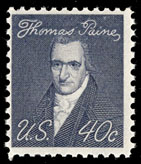
Wiek rozumu (1794)
Thomas Paine: 272 cytaty0 Polubień
Thomas Paine słynne cytaty
Wiek rozumu (1794)
Thomas Paine książka Zdrowy rozsądek
o Wilhelmie Zdobywcy, odrzucając ideę władzy królewskiej i deprecjonując pochodzenie brytyjskiej monarchii.
Zdrowy rozsądek (1776)
Thomas Paine książka Zdrowy rozsądek
Zdrowy rozsądek (1776)
Thomas Paine książka Zdrowy rozsądek
Zdrowy rozsądek (1776)
Thomas Paine cytaty
„Uczestniczenie w dwóch rewolucjach oznacza, że życie ma pewien cel.”
w liście do George'a Washingtona (1789)
Źródło: Christopher Hitchens, Thomas Paine. Prawa człowieka. Biografia
Wiek rozumu (1794)
Thomas Paine: Cytaty po angielsku
1790s, Agrarian Justice (1797)
Thomas Paine książka Rights of Man
Part 1.3 Rights of Man
1790s, Rights of Man, Part I (1791)
“These are the sentiments of JUSTICE AND HUMANITY.”
1770s, African Slavery in America (March 1775)
Thomas Paine książka Rights of Man
Part 1.3 Rights of Man
1790s, Rights of Man, Part I (1791)
As quoted in The Writings of Thomas Paine, edited by Moncure D. Conway, vol. 3 (1895), p. 252
1790s, Letter to George Washington (1796)
Thomas Paine książka Rights of Man
Part 1.3 Rights of Man
1790s, Rights of Man, Part I (1791)
1770s, African Slavery in America (March 1775)
1790s, Discourse to the Theophilanthropists (1798)
Thomas Paine książka Rights of Man
Part Two, Chapter V. Ways and means of improving the condition of Europe, interspersed with miscellaneous observations.
1790s, Rights of Man, Part 2 (1792)
1770s, African Slavery in America (March 1775)
Thomas Paine książka Rights of Man
Part 1.3 Rights of Man
1790s, Rights of Man, Part I (1791)
1790s, Discourse to the Theophilanthropists (1798)
1770s, African Slavery in America (March 1775)
“Aristocracy is kept up by family tyranny and injustice.”
Thomas Paine książka Rights of Man
Part 1.3 Rights of Man
1790s, Rights of Man, Part I (1791)
Thomas Paine książka Rights of Man
Part 2.7 Chapter V. Ways and means of improving the condition of Europe, interspersed with miscellaneous observations
1790s, Rights of Man, Part 2 (1792)
Prospects on the Rubicon http://books.google.com/books?id=PN9bAAAAQAAJ&q=%22War+involves+in+its+progress+such+a+train+of+unforseen+and+unsupposed+circumstances%22+%22that+no+human+wisdom+can+calculate+the+end%22&pg=PA5#v=onepage (1787). <br class="br">1780s
1770s, African Slavery in America (March 1775)
Thomas Paine książka The Age of Reason
1790s, The Age of Reason, Part I (1794)
The Crisis No. V http://www.gutenberg.org/files/3741/3741-h/3741-h.htm#link2H_4_0009 <br class="br">1770s, The American Crisis (1776&ndash;1783)
Thomas Paine książka Rights of Man
Part 1.3 Rights of Man
1790s, Rights of Man, Part I (1791)
Thomas Paine książka The Age of Reason
1790s, The Age of Reason, Part II (1795)
Thomas Paine książka Rights of Man
Part 2.2 Introduction
1790s, Rights of Man, Part 2 (1792)
Thomas Paine książka Rights of Man
Preface
1790s, Rights of Man, Part 2 (1792)
1770s, African Slavery in America (March 1775)
Thomas Paine książka The Age of Reason
Revelation, when applied to religion, means something communicated immediately from God to man.
No one will deny or dispute the power of the Almighty to make such a communication, if he pleases. But admitting, for the sake of a case, that something has been revealed to a certain person, and not revealed to any other person, it is revelation to that person only. When he tells it to a second person, a second to a third, a third to a fourth, and so on, it ceases to be a revelation to all those persons. It is revelation to the first person only, and hearsay to every other, and consequently they are not obliged to believe it.
When Moses told the children of Israel that he received the two tables of the commandments from the hands of God, they were not obliged to believe him, because they had no other authority for it than his telling them so; and I have no other authority for it than some historian telling me so. The commandments carry no internal evidence of divinity with them; they contain some good moral precepts, such as any man qualified to be a lawgiver, or a legislator, could produce himself, without having recourse to supernatural intervention.
When I am told that the Koran was written in Heaven, and brought to Mahomet by an angel, the account comes too near the same kind of hearsay evidence and second-hand authority as the former. I did not see the angel myself, and, therefore, I have a right not to believe it.
When also I am told that a woman called the Virgin Mary, said, or gave out, that she was with child without any cohabitation with a man, and that her betrothed husband, Joseph, said that an angel told him so, I have a right to believe them or not: such a circumstance required a much stronger evidence than their bare word for it; but we have not even this — for neither Joseph nor Mary wrote any such matter themselves; it is only reported by others that they said so — it is hearsay upon hearsay, and I do not choose to rest my belief upon such evidence.
1790s, The Age of Reason, Part I (1794)


