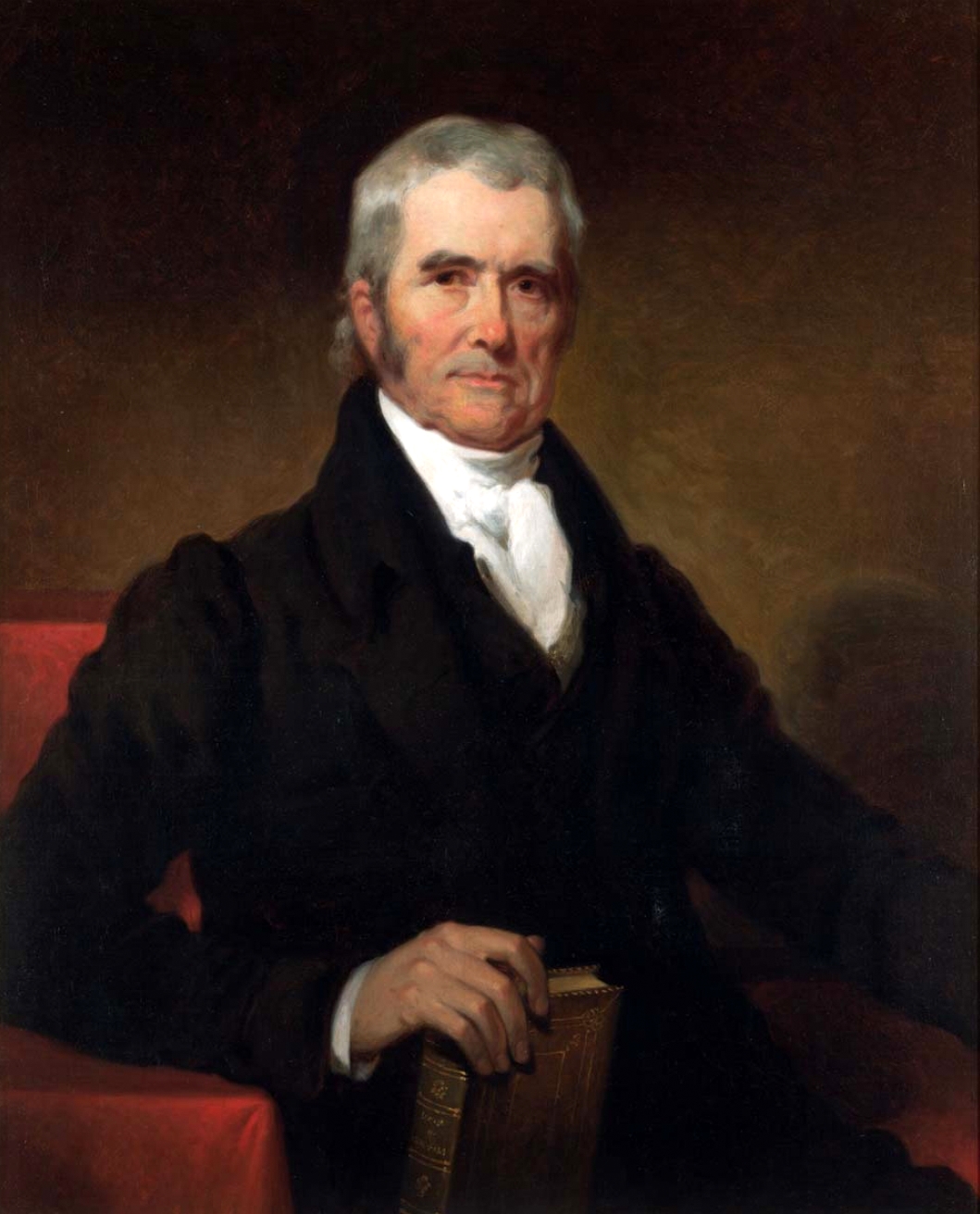
John Marshall cytaty
strona 2

John Marshall – czwarty prezes Sądu Najwyższego Stanów Zjednoczonych i czwarty sekretarz stanu Stanów Zjednoczonych.

W latach 1799-1800 podczas szóstej kadencji Kongresu Stanów Zjednoczonych reprezentował stan Wirginia w Izbie Reprezentantów Stanów Zjednoczonych.

Marshall przewodniczył Sądowi Najwyższemu najdłużej ze wszystkich przewodniczących, bo aż 34 lata, a dokładnie 12 570 dni. Spośród wszystkich 110 sędziów sądu tylko dwóch zasiadało na urzędzie dłużej. Za jego kadencji w składzie sądu zasiadało 15 różnych sędziów, a urząd prezydenta Stanów Zjednoczonych pełniło 6 różnych osób.

To on zrównał pod względem znaczenia Sąd Najwyższy z dwiema pozostałymi gałęziami władzy federalnej[potrzebny przypis].

Jego kuzyn, Humphrey Marshall, reprezentował stan Kentucky w Senacie Stanów Zjednoczonych. Wikipedia  

✵ 24. Wrzesień 1755 – 6. Lipiec 1835
John Marshall Fotografia
John Marshall: 42 cytaty0 Polubień

John Marshall cytaty

„Władza podatkowa – to władza niszczenia.”

John Marshall

o podatkach.

John Marshall: Cytaty po angielsku

“The acme of judicial distinction means the ability to look a lawyer straight in the eyes for two hours and not hear a damned word he says.”

John Marshall

Reportedly said to a young John Bannister Gibson, who later became Chief Justice of the Supreme Court of Pennsylvania, when Gibson remarked that Marshall had reached the acme of judicial distinction; in David Goldsmith Loth, Chief Justice: John Marshall and the Growth of the Republic (1949), p. 275. See also Albert J. Beveridge, "Life of John Marshall" (1919)

“No trace is to be found in the Constitution of an intention to create a dependence of the Government of the Union on those of the States, for the execution of the great powers assigned to it. Its means are adequate to its ends, and on those means alone was it expected to rely for the accomplishment of its ends. To impose on it the necessity of resorting to means which it cannot control, which another Government may furnish or withhold, would render its course precarious, the result of its measures uncertain, and create a dependence on other Governments which might disappoint its most important designs, and is incompatible with the language of the Constitution.”

John Marshall

17 U.S. (4 Wheaton) 316, 424
McCulloch v. Maryland (1819)
Kontekst: [.. ] it can scarcely be necessary to say that the existence of State banks can have no possible influence on the question. No trace is to be found in the Constitution of an intention to create a dependence of the Government of the Union on those of the States, for the execution of the great powers assigned to it. Its means are adequate to its ends, and on those means alone was it expected to rely for the accomplishment of its ends. To impose on it the necessity of resorting to means which it cannot control, which another Government may furnish or withhold, would render its course precarious, the result of its measures uncertain, and create a dependence on other Governments which might disappoint its most important designs, and is incompatible with the language of the Constitution. But were it otherwise, the choice of means implies a right to choose a national bank in preference to State banks, and Congress alone can make the election. After the most deliberate consideration, it is the unanimous and decided opinion of this Court that the act to incorporate the Bank of the United States is a law made in pursuance of the Constitution, and is a part of the supreme law of the land.

“But all legislative powers appertain to sovereignty. The original power of giving the law on any subject whatever is a sovereign power […] All admit that the Government may legitimately punish any violation of its laws, and yet this is not among the enumerated powers of Congress. The right to enforce the observance of law by punishing its infraction might be denied with the more plausibility because it is expressly given in some cases. Congress is empowered "to provide for the punishment of counterfeiting the securities and current coin of the United States," and "to define and punish piracies and felonies committed on the high seas, and offences against the law of nations." The several powers of Congress may exist in a very imperfect State, to be sure, but they may exist and be carried into execution, although no punishment should be inflicted, in cases where the right to punish is not expressly given. Take, for example, the power "to establish post-offices and post-roads." This power is executed by the single act of making the establishment. But from this has been inferred the power and duty of carrying the mail along the post road from one post office to another. And from this implied power has again been inferred the right to punish those who steal letters from the post office, or rob the mail. It may be said with some plausibility that the right to carry the mail, and to punish those who rob it, is not indispensably necessary to the establishment of a post office and post road. This right is indeed essential to the beneficial exercise of the power, but not indispensably necessary to its existence. So, of the punishment of the crimes of stealing or falsifying a record or process of a Court of the United States, or of perjury in such Court. To punish these offences is certainly conducive to the due administration of justice. But Courts may exist, and may decide the causes brought before them, though such crimes escape punishment. The baneful influence of this narrow construction on all the operations of the Government, and the absolute impracticability of maintaining it without rendering the Government incompetent to its great objects, might be illustrated by numerous examples drawn from the Constitution and from our laws. The good sense of the public has pronounced without hesitation that the power of punishment appertains to sovereignty, and may be exercised, whenever the sovereign has a right to act, as incidental to his Constitutional powers. It is a means for carrying into execution all sovereign powers, and may be used although not indispensably necessary. It is a right incidental to the power, and conducive to its beneficial exercise.”

John Marshall

17 U.S. (4 Wheaton) 316, 409 and 416-418. Regarding the Necessary and Proper Clause in context of the powers of Congress.
McCulloch v. Maryland (1819)

“We must never forget that it is a constitution we are expounding.”

John Marshall

17 U.S. (4 Wheaton) 316, 407
McCulloch v. Maryland (1819)

Podobni autorzy

Otto von Bismarck Fotografia
Otto von Bismarck38
niemiecki polityk None
Theodore Roosevelt Fotografia
Theodore Roosevelt15
prezydent USA None
Benjamin Disraeli Fotografia
Benjamin Disraeli17
polityk brytyjski None
Emily Dickinson Fotografia
Emily Dickinson8
poetka amerykańska None
Walt Whitman Fotografia
Walt Whitman16
poeta amerykański None
Ralph Waldo Emerson Fotografia
Ralph Waldo Emerson78
filozof amerykański None
Pierre-Joseph Proudhon Fotografia
Pierre-Joseph Proudhon88
francuski polityk i filozof None
Wiktor Hugo Fotografia
Wiktor Hugo68
francuski pisarz i polityk None
Charles-Maurice de Talleyrand Fotografia
Charles-Maurice de Talleyrand34
francuski polityk None
Henry David Thoreau Fotografia
Henry David Thoreau94
amerykański pisarz, poeta i filozof None