Herbert Spencer cytaty
strona 3

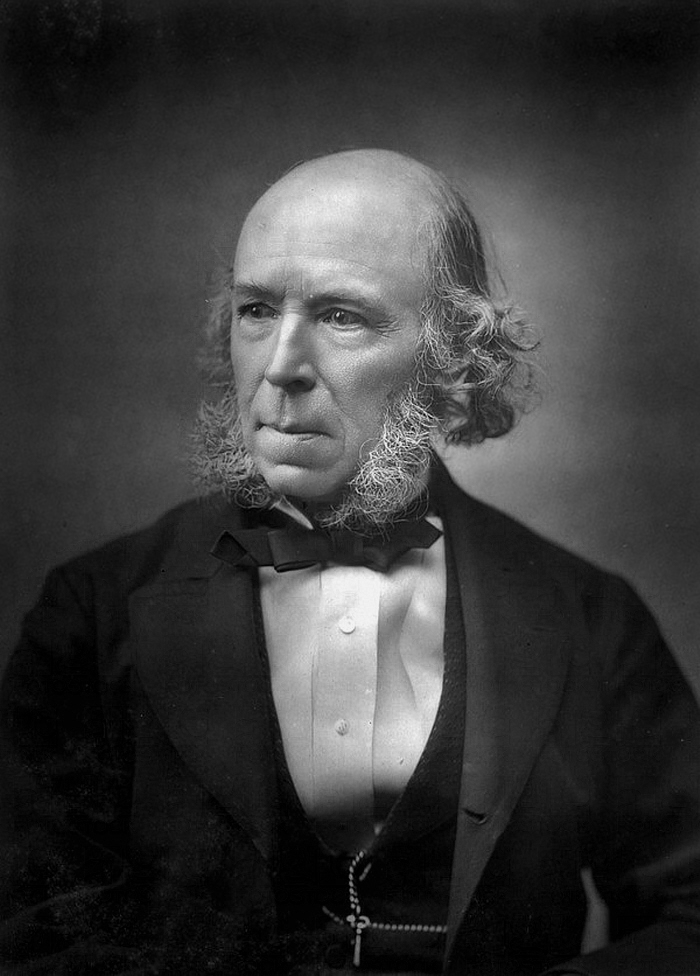
Herbert Spencer – angielski filozof i socjolog.

✵ 27. Kwiecień 1820 – 8. Grudzień 1903
Herbert Spencer Fotografia
Herbert Spencer: 84 cytaty1 Polubienie

Herbert Spencer słynne cytaty

„Opinie ostatecznie są kształtowane przez uczucia, nie rozum.”

Herbert Spencer

Opinion is ultimately determined by the feelings, and not by the intellect. (ang.) <br class="br">Źródło: Social Statics, or The Conditions essential to Happiness specified, and the First of them Developed http://www.archive.org/stream/cu31924077682825#page/n7/mode/2up, John Chapman, Londyn 1851, rozdział 30.

Herbert Spencer: Cytaty po angielsku

“Originally, ethics has no existence apart from religion, which holds it in solution.”

Herbert Spencer

Źródło: The Principles of Ethics (1897), Part II: The Inductions of Ethics, Ch. 1, The Confusion of Ethical Thought

“Equity knows no difference of sex. In its vocabulary the word man must be understood in a generic, and not in a specific sense.”

Herbert Spencer książka Social Statics

Pt. II, Ch. 16 : The Rights of Women
Social Statics (1851)

“Evil perpetually tends to disappear.”

Herbert Spencer książka Social Statics

Part I, Ch. 2 : The Evanescence of Evil, § 2
Social Statics (1851)

“There is a principle which is a bar against all information, which is proof against all arguments and which cannot fail to keep a man in everlasting ignorance — that principle is contempt prior to investigation.”

Herbert Spencer

Commonly attributed to Spencer, information provided in The Quote Verifier: Who Said What, Where, and When (2006) by Ralph Keyes and The Survival of a Fitting Quotation. (2005) by Michael StGeorge http://anonpress.org/spencer/, indicates the attribution may have originated with the book [w:The_Big_Book_(Alcoholics_Anonymous)|Alcoholics Anonymous]]. It was used exactly as written above in the personal stories section of the first edition in 1939 and in &#x27;Appendix II: Spiritual Experience&#x27; of all subsequent editions.<br>: &quot;Contempt prior to examination&quot; was a phrase used by William Paley, the 18th-century English Christian apologist. In A View of the Evidences of Christianity (1794), he wrote:<br>::The infidelity of the Gentile world, and that more especially of men of rank and learning in it, is resolved into a principle which, in my judgment, will account for the inefficacy of any argument, or any evidence whatever, viz. contempt prior to examination.<br>:Paley&#x27;s characterization of non-believers was later modified and used by other religious authors who uniformly attributed their words to Paley. In Anglo-Israel or, The British Nation: The lost Tribes of Israel (1879), Rev. William H. Poole may have been the first to render the quotation in its more familiar and enduring form:<br>::There is a principle which is a bar against all information, which is proof against all argument, and which cannot fail to keep a man in everlasting ignorance. This principle is, contempt prior to examination.<br>:Various authors following Rev. Poole would offer new iterations of the quotation into the early decades of the 20th century. Most of these credited William Paley, but by the early 1930s the first obscure publications to falsely attribute this quote to Spencer emerged. Its usage for decades since as a maxim in Alcoholics Anonymous and the twelve-step recovery community has popularized its erroneous association with Herbert Spencer. <br class="br">Misattributed
“Volumes might be written upon the impiety of the pious.”

Herbert Spencer

Pt. I, The Unknowable; Ch. V, The Reconciliation
First Principles (1862)

“Every cause produces more than one effect.”

Herbert Spencer

On Progress: Its Law and Cause
Essays on Education (1861)

“With a higher moral nature will come a restriction on the multiplication of the inferior.”

Herbert Spencer

The Principles of Biology, Vol. II (1867), Part VI: Laws of Multiplication, ch. 8: Human Population in the Future
Principles of Biology (1864)

“The supporters of the Development Hypothesis… can show that any existing species—animal or vegetable—when placed under conditions different from its previous ones, immediately begins to undergo certain changes fitting it for the new conditions.”

Herbert Spencer

They can show that in successive generations these changes continue; until, ultimately, the new conditions become the natural ones. They can show that in cultivated plants, in domesticated animals, and in the several races of men, such alterations have taken place. They can show that the degrees of difference so produced are often, as in dogs, greater than those on which distinctions of species are in other cases founded.
The Development Hypothesis (1852)

“No human laws are of any validity if contrary to the law of nature; and such of them as are valid derive all their force and all their authority mediately or immediately from this original.”

Herbert Spencer książka Social Statics

Thus writes Blackstone, to whom let all honour be given for having so far outseen the ideas of his time; and, indeed, we may say of our time. A good antidote, this, for those political superstitions which so widely prevail. A good check upon that sentiment of power-worship which still misleads us by magnifying the prerogatives of constitutional governments as it once did those of monarchs. Let men learn that a legislature is not “our God upon earth,” though, by the authority they ascribe to it, and the things they expect from it, they would seem to think it is. Let them learn rather that it is an institution serving a purely temporary purpose, whose power, when not stolen, is at the best borrowed.
Pt. III, Ch. 19 : The Right to Ignore the State, § 2
Social Statics (1851)

Podobni autorzy

Karol Marks Fotografia
Karol Marks136
niemiecki filozof, ekonomista i działacz rewolucyjny None
John Henry Newman Fotografia
John Henry Newman10
angielski teolog katolicki, filozof, kardynał None
John Stuart Mill Fotografia
John Stuart Mill19
angielski filozof, politolog i ekonomista None
Arthur Schopenhauer Fotografia
Arthur Schopenhauer97
filozof niemiecki None
Georg Wilhelm Friedrich Hegel Fotografia
Georg Wilhelm Friedrich Hegel26
filozof niemiecki None
Percy Bysshe Shelley Fotografia
Percy Bysshe Shelley6
angielski poeta None
Robert Browning Fotografia
Robert Browning8
angielski poeta None
Henry David Thoreau Fotografia
Henry David Thoreau94
amerykański pisarz, poeta i filozof None
William James Fotografia
William James26
filozof i psycholog amerykański None
Jane Austen Fotografia
Jane Austen44
angielska pisarka None