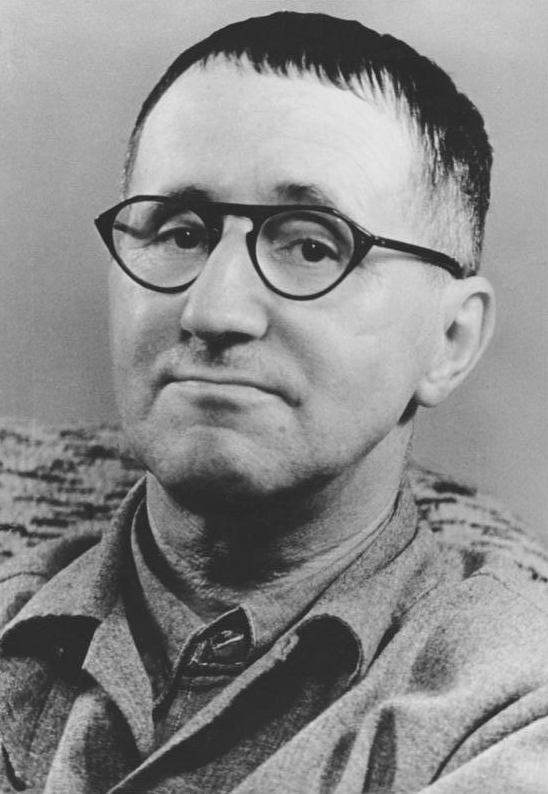
Źródło: Nic, co ludzkie… Aforyzmy, sentencje i przysłowia, oprac. Henryk Jurand, LSW, 1982, s. 116.
Bertolt Brecht: 151 cytatów9 Polubień
Bertolt Brecht słynne cytaty
Źródło: Co za pożytek z dobroci?, w: O trudnościach rządzenia, Zielona Góra 2004
„Kto walczy, może przegrać. Kto nie walczy, już przegrał.”
Wer kämpft, kann verlieren. Wer nicht kämpft, hat schon verloren. (niem.)
Źródło: John Redcliff, Odyssee Im All, S. Verlag JG, 2013.
Bertolt Brecht Cytaty o myślach
„Niebezpieczeństwo trwa zwykle dłużej niż ucieczka.”
Źródło: Myśli ludzi wielkich, średnich i psa Fafika, „Przekrój”, wyd. 1–13, Krakowskie Wydawnictwo Prasowe, 2000, s. 122.
„Terror potęguje strach i odwagę, dwie właściwości bardzo niebezpieczne dla dyktatorów.”
Źródło: Leksykon złotych myśli, wyboru dokonał Krzysztof Nowak, Warszawa 1998
„Myślenie jest czymś, co następuje po trudnościach i poprzedza działanie.”
Źródło: Od księgoznawstwa przez bibliotekoznawstwo do nauki o informacji XXI wieku, oprac. Jan Leończuk, Książnica Podlaska im. Łukasza Górnickiego, 2007, s. 100.
„Piękne dzieciństwo ma się tylko raz.”
Źródło: Leksykon złotych myśli, wyboru dokonał Krzysztof Nowak, Warszawa 1998
„Miłość jest pragnieniem, aby komuś coś dawać – a nie otrzymywać.”
Źródło: Leksykon złotych myśli, wyboru dokonał Krzysztof Nowak, Warszawa 1998
Bertolt Brecht cytaty
Andrea: Unglücklich das Land, das keine Helden hat.<br/ >Galilei: Unglücklich das Land, das Helden nötig hat. (niem.)
Życie Galileusza (1939)
„Czyż nie byłoby przecież prostszym rozwiązaniem,
gdyby rząd
rozwiązał naród
i wybrał drugi?”
…) Wäre es da
Nicht doch einfacher, die Regierung
Löste das Volk auf und
Wählte ein anderes? (niem.
o powstaniu robotniczym w NRD przeciw władzom komunistycznym, które wybuchło w czerwcu 1953.
Źródło: Rozwiązanie, 1953
Małe organon dla teatru
Wer baute das siebentorige Theben
In den Büchern stehen die Namen von Königen.
Haben die Könige die Felsbrocken herbeigeschleppt? (…)
Wohin gingen an dem Abend, wo die chinesische Mauer fertig war,
Die Maurer? (…) (niem.)
Źródło: Pytania czytającego robotnika (1935)
Źródło: Joachim Glensk, Niemcy w opinii własnej i świata
„Zaprawdę, żyję w ponurej epoce!”
Wirklich, ich lebe in finsteren Zeiten! (niem.)
Źródło: Do potomnych, 1939, tłum. Stanisław Jerzy Lec
O Bertoldzie Brechcie
Źródło: Herbert Lüthy, Du Pauvre Bertold Brecht (1953)
„Najpierw żarcie, potem moralność.”
Bertolt Brecht Opera za trzy grosze
Denn erst kommt das Fressen, und dann kommt die Moral (niem.)
Opera za trzy grosze (1928)
„Toć raj na ziemi stworzyć każdy chce. Ale czy forsę ma? Niestety, nie!”
Bertolt Brecht Opera za trzy grosze
Opera za trzy grosze (1928)
„O losie człowieka decyduje człowiek.”
Źródło: Nic, co ludzkie… Aforyzmy, sentencje i przysłowia, oprac. Henryk Jurand, LSW, 1982, s. 14.
„Ci, którzy nie posuwają naprzód żadnego życia poza swoim własnym, żyją nieciekawie.”
Źródło: Księga Mądrości, wyb. Maciej Dominiczak
Bertolt Brecht Opera za trzy grosze
Was ist ein Einbruch in eine Bank gegen die Gründung einer Bank? Was ist die Ermordung eines Mannes gegen die Anstellung eines Mannes? (niem.)
Opera za trzy grosze (1928)
„Niech więc triumf przedwczesny do głów nie uderza,płodne jest ciągle łono, co wydało zwierza.”
Bertolt Brecht książka Kariera Artura Ui
Źródło: Kariera Artura Ui
„Człowiek chętniej hołduje dobru niźli złu, ale warunki mu nie sprzyjają.”
Bertolt Brecht Opera za trzy grosze
Opera za trzy grosze (1928)
Źródło: Pieśń o ukochanej, tłum. Jacek St. Buras
„Na diabła wolność, gdy masz głodny być!
Tylko w komforcie można mile żyć!”
Źródło: Czas mego bogactwa w: Wiersze wybrane, Warszawa 1954, s. 101, tłum. Stanisław Jerzy Lec.
Małe organon dla teatru
O Bertoldzie Brechcie
Źródło: Artur Koestler, The Invisible Writing (1954)
Bertolt Brecht Matka Courage i jej dzieci
Źródło: Matka Courage i jej dzieci, scena 6, tłum. Stanisław Jerzy Lec
Źródło: Matka, tłum. R. Szydłowski w: Dramaty, Warszawa 1970, s. 268.
Bertolt Brecht: Cytaty po angielsku
“Unhappy is the land that needs a hero.”
Bertolt Brecht książka Life of Galileo
Scene 12, p. 115
Variant translations: Pity the country that needs heroes.
Unhappy the land that is in need of heroes
Źródło: Andrea: Unhappy is the land that breeds no hero.
Galileo: No, Andrea: Unhappy is the land that needs a hero. [Unglücklich das Land, das Helden nötig hat. ]
Źródło: Poems 1913-1956
Źródło: Brecht on Theatre: The Development of an Aesthetic
“To live means to finesse the processes to which one is subjugated.”
"Notes on Philosophy" in On Politics and Society (1941).
“Mixing one's wines may be a mistake, but old and new wisdom mix admirably.”
The Singer, in The Caucasian Chalk Circle (1944), Prologue
"Great hymn of thanksgiving" [Grosser Dankchoral] (1920) from The Devotions (1922-1927); trans. Karl Neumann in Poems, 1913-1956, p. 74
Poems, 1913-1956 (1976)
“What if they gave a war and no one came? Then the war will come to you.”
Amalgamation of Carl Sandburg's quote "Sometime they’ll give a war and nobody will come" with a sentence from Brecht's Koloman Wallisch Kantate: "When the people are disarmed / War will come" ("Wenn das Volk entwaffnet ist / Kommt der Krieg"). - Source http://www.cyberussr.com/hcunn/q-war-nobody-came.html <br class="br">Misattributed
Bertolt Brecht Opera za trzy grosze
Peachum in Act 1, scene 1, pp. 5-6
The Threepenny Opera (1928)
Bertolt Brecht The Mother
Pelagea Vlasova in Scene 10
The Mother (1930)
“But something's missing (Aber etwas fehlt).”
Jim[my] Mahoney, in Rise and Fall of the City of Mahagonny (1930)
"Of all the works of man" [Von allen Werken] (c. 1932) in Poems, 1913-1956, p. 192
Poems, 1913-1956 (1976)
“The more innocent they are, the more they deserve to be shot.”
On defendants in the Moscow Trials and on innocents betrayed by Communist Party members, as recounted by philosopher Sidney Hook, as quoted in Intellectuals (1990) by Paul Johnson, p. 190; though this might easily be interpreted as implying that anyone who had failed to conspire against Stalin deserved to be shot, Hook implies that he meant that the betrayal of innocents was justified. Henry Pachter is also quoted in Intellectuals as saying that Brecht had made similar remarks in his presence, and had added "Fifty years hence the communists will have forgotten Stalin, but I want to be sure that they will still read Brecht. Therefore I cannot separate myself from the Party."
"Questions from a worker who reads" [Fragen eines lesenden Arbeiters] (1935) from The Svendborg Poems (1939); trans. Michael Hamburger in Poems, 1913-1956, p. 252
Poems, 1913-1956 (1976)
“For once you must try not to shirk the facts:
Mankind is kept alive by bestial acts.”
Bertolt Brecht Opera za trzy grosze
"What Keeps Mankind Alive?" Act 2, sc. 6
The Threepenny Opera (1928)
“Come in, dear wind, and be our guest
You too have neither home nor rest.”
"Christmas legend" [Weinachtslegende] (1923) Berliner Börsen-Courier (25 December 1924); trans in Poems, 1913-1956, p. 100
Poems, 1913-1956 (1976)
“Come fishing with me, said the fisherman to the worm.”
Komm, geh mit angeln, sagte der Fischer zum Wurm.
Mutter Courage to the army recruiter when he tries to recruit her son in Scene 1
Mother Courage and Her Children (1939)
"Song of the cut-price poets" [Lied der preiswerten Lyriker] (1927/1933) from Songs Poems Choruses (1934); in Poems, 1913-1956, p. 161
Poems, 1913-1956 (1976)
Bertolt Brecht A Short Organum for the Theatre
¶ 35
A Short Organum for the Theatre (1949)
“For the task assigned them
Men aren't smart enough or sly
Any rogue can blind them
With a clever lie.”
Bertolt Brecht Opera za trzy grosze
Polly Peachum, in "The Song of the Futility of All Human Endeavor"; Act 3, scene 1, p. 75
The Threepenny Opera (1928)
"And I always thought" [Und ich dachte immer] (c. 1956), trans. Michael Hamburger in Poems, 1913-1956, p. 452
Poems, 1913-1956 (1976)


