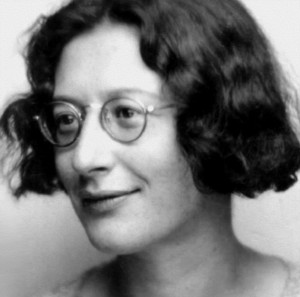
Simone Weil słynne cytaty
C’est seulement pour celui qui a connu la joie pure, ne fût-ce qu’une minute, et par suite la saveur de la beauté du monde, car c’est la même chose, c’est pour celui-là seul que le malheur est quelque chose de déchirant. (fr.)
Źródło: Pensées sans ordre concernant l’amour de Dieu, Éditions Gallimard, Paryż 1962.
Simone Weil Cytaty o miłości
Simone Weil Cytaty o pięknie
poprzez złudzenie
Źródło: Świadomość nadprzyrodzona. Wybór myśli
Simone Weil cytaty
„Religia jako źródło pociechy jest przeszkodą prawdziwej wiary.”
Źródło: Maria Janion, Niesamowita Słowiańszczyzna, Wydawnictwo Literackie, Kraków 2007, s. 193.
„Cała geometria wywodzi się z krzyża.”
All geometry proceeds from the Cross. <br class="br">Źródło: First and last notebooks http://books.google.pl/books?ei=NPsdTZn3LsKSOtffxbcJ&ct=result&id=dH0PAQAAIAAJ&dq=all+geometry+proceeds+from+the+Cross+Weil&q=geometry+proceeds+from+the+Cross#search_anchor, Oxford University Press, 1970, s. 98.
Simone Weil: Cytaty po angielsku
Letter from Simone Weil to her parents, August 1943, five weeks before her death, quoted in introduction, p. 1
Lectures on Philosophy (1959)
La force qui tue est une forme sommaire, grossière de la force. Combien plus variée en ses procédés, combien plus surprenante en ses effets, est l'autre force, celle qui ne tue pas; c'est-à-dire celle qui ne tue pas encore.
in The Simone Weil Reader, p. 155
Simone Weil : An Anthology (1986), The Iliad or The Poem of Force (1940-1941)
“The responsibility of writers,” p. 167
On Science, Necessity, and the Love of God (1968)
Letter to Georges Bernanos (1938), in Seventy Letters, as translated by Richard Rees (Wipf and Stock: 1965), p. 105
Si tous sont destinés en naissant à souffrir la violence, c'est là une vérité à laquelle l'empire des circonstances ferme les esprits des hommes.
in The Simone Weil Reader, p. 163
Simone Weil : An Anthology (1986), The Iliad or The Poem of Force (1940-1941)
Źródło: Simone Weil : An Anthology (1986), Human Personality (1943), p. 55
“The miser deprives himself of his treasure because of his desire for it.”
Źródło: Simone Weil : An Anthology (1986), Detachment (1947), p. 260
Źródło: Simone Weil : An Anthology (1986), Human Personality (1943), p. 57
“The simultaneous existence of opposite virtues in the soul — like pincers to catch hold of God.”
Simone Weil książka Gravity and Grace
Źródło: Gravity and Grace (1947), p. 92 (1972 edition)
"Reflections on the Right Use of School Studies with a View to the Love of God"
Waiting on God (1950)
Simone Weil książka Gravity and Grace
… It is by this twist that slavery debases the soul: this devotion is in fact based on a lie, since the reasons for it cannot bear investigation. … Moreover, the master is deceived too by the fallacy of devotion.
Źródło: Gravity and Grace (1947), p. 142 (1972 edition)
The only mark of God in us is that we feel that we are not God.
p. 90
Lectures on Philosophy (1959)


