
Nassim Nicholas Taleb książka Antifragile: Things That Gain from Disorder
Źródło: Antifragile: Things That Gain from Disorder (2012), p. 79
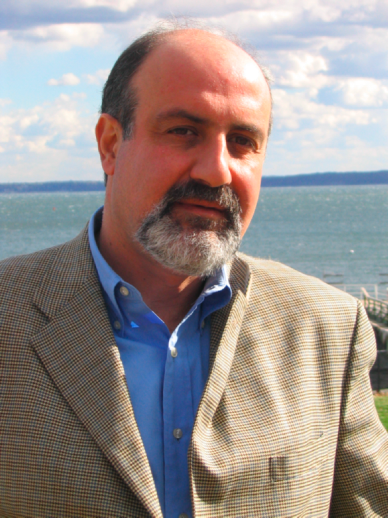
Nassim Nicholas Taleb – amerykański ekonomista, filozof i trader pochodzenia libańskiego. Magister nauk przyrodniczych i doktor zarządzania. W swoich pracach skupia się na zagadnieniach prawdopodobieństwa, przypadkowości i niepewności. Obecnie profesor Uniwersytetu Nowojorskiego .
Autor bestsellerów Czarny Łabędź. O skutkach nieprzewidywalnych zdarzeń oraz Antykruchość. O rzeczach, którym służą wstrząsy. Wikipedia
Nassim Nicholas Taleb książka Antifragile: Things That Gain from Disorder
Źródło: Antifragile: Things That Gain from Disorder (2012), p. 79
Quoted in the introduction to "A Talk with Nassim Nicholas Taleb," Edge (April 2004) http://www.edge.org/3rd_culture/taleb04/taleb_index.html
Nassim Nicholas Taleb książka The Bed of Procrustes: Philosophical and Practical Aphorisms
Źródło: The Bed of Procrustes: Philosophical and Practical Aphorisms (2010), p. 56
Nassim Nicholas Taleb książka Fooled by Randomness
Fooled by Randomness (2001)
Nassim Nicholas Taleb książka The Bed of Procrustes: Philosophical and Practical Aphorisms
Źródło: The Bed of Procrustes: Philosophical and Practical Aphorisms (2010), p. 65
Nassim Nicholas Taleb książka The Bed of Procrustes: Philosophical and Practical Aphorisms
Źródło: The Bed of Procrustes: Philosophical and Practical Aphorisms (2010), p. 107
Źródło: The Black Swan: The Impact of the Highly Improbable (2007), p. 198
Nassim Nicholas Taleb książka The Bed of Procrustes: Philosophical and Practical Aphorisms
Źródło: The Bed of Procrustes: Philosophical and Practical Aphorisms (2010), p. 17
“If you see fraud and do not say fraud, you are a fraud.”
Nassim Nicholas Taleb książka Antifragile: Things That Gain from Disorder
Źródło: Antifragile: Things That Gain from Disorder (2012), p. 15
“Consider that the turkey's experience may have, rather than no value, a negative value.”
Nassim Nicholas Taleb książka The Black Swan
It learned from observation, as we are all advised to do (hey, after all, this is what is believed to be the scientific method). Its confidence increased as the number of friendly feedings grew, and it felt increasingly safe even though the slaughter was more and more imminent. Consider that the feeling of safety reached its maximum when the risk was at the highest!
Źródło: The Black Swan: The Impact of the Highly Improbable (2007), pp. 40–41 (Taleb attributes the parable of the turkey to Bertrand Russell, who originally wrote of a chicken.)
“Survival comes first, truth, understanding, and science later.”
Nassim Nicholas Taleb książka Skin in the Game
Źródło: Skin in the Game (2018), p. 214
Nassim Nicholas Taleb książka Skin in the Game
Źródło: Skin in the Game (2018), p. 185
Nassim Nicholas Taleb książka Skin in the Game
Źródło: Skin in the Game (2018), p. 162
Nassim Nicholas Taleb książka Skin in the Game
Źródło: Skin in the Game (2018), p. 23
Nassim Nicholas Taleb książka Skin in the Game
Źródło: Skin in the Game (2018), p. 12
Nassim Nicholas Taleb książka Skin in the Game
Źródło: Skin in the Game (2018), p. 7