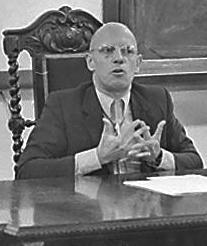
Michel Foucault słynne cytaty
„Władzę suwerenną zastąpiła dziś władza pastoralna.”
Michel Foucault Historia seksualności
Źródło: Historia seksualności
Źródło: Intelektualiści a władza (rozmowa między Michelem Foucault a Gilles’em Deluze’em), przeł., Sławomir Magala, „Miesięcznik Literacki”, nr 11/1985.
„Ani władza nie może być praktykowana bez wiedzy, ani wiedza nie może nie płodzić władzy.”
Źródło: Gry władzy, tłum. T. Komendant, [w:] Literatura na świecie, nr 6/1988.
Michel Foucault Cytaty o historii
Michel Foucault Historia seksualności
Źródło: Historia seksualności, t. 1 Wola wiedzy, tłum.B. Banasiak, K. Matuszewski, Czytelnik, Warszawa 2000.
Michel Foucault cytaty
Źródło: Nadzorować i karać. Narodziny więzienia, tłum. T. Komendant, Fundacja Aletheia, Warszawa 1998.
Źródło: Intelektualiści a władza (rozmowa między Michelem Foucault a Gilles’em Deluze’em), przeł., Sławomir Magala, „Miesięcznik Literacki”, nr 11/1985.
Źródło: Porządek dyskursu, tłum.M. Kozłowski, wyd.: Słowo/Obraz Terytoria, Gdańsk 2002.
Źródło: Gry władzy, tłum.T. Komendant, [w:] Literatura na świecie, nr 6/1988.
Michel Foucault: Cytaty po angielsku
“What desire can be contrary to nature since it was given to man by nature itself?”
Źródło: Madness and Civilization: A History of Insanity in the Age of Reason
Źródło: The Birth of the Clinic: An Archaeology of Medical Perception
Michel Foucault książka Discipline and Punish
Źródło: Discipline and Punish: The Birth of the Prison
As quoted in Michel Foucault (1991) by Didier Eribon, as translated by Betsy Wind, Harvard University Press, p. 282
Kontekst: There are more ideas on earth than intellectuals imagine. And these ideas are more active, stronger, more resistant, more passionate than "politicians" think. We have to be there at the birth of ideas, the bursting outward of their force: not in books expressing them, but in events manifesting this force, in struggles carried on around ideas, for or against them. Ideas do not rule the world. But it is because the world has ideas (and because it constantly produces them) that it is not passively ruled by those who are its leaders or those who would like to teach it, once and for all, what it must think.
“The individual is the product of power.”
Źródło: Anti-Oedipus: Capitalism and Schizophrenia
“there is no glory in punishing”
Michel Foucault książka Discipline and Punish
Źródło: Discipline and Punish: The Birth of the Prison
Źródło: The History of Sexuality, Volume 1: An Introduction
“The language of psychiatry is a monologue of reason about madness”
Preface to 1961 edition
History of Madness (1961)
Kontekst: The constitution of madness as mental illness, at the end of the eighteenth century, bears witness to a rupture in a dialogue, gives the separation as already enacted, and expels from the memory all those imperfect words, of no fixed syntax, spoken falteringly, in which the exchange between madness and reason was carried out. The language of psychiatry, which is a monologue by reason about madness, could only have come into existence in such a silence.
Źródło: The History of Sexuality, Volume 2: The Use of Pleasure
Preface to 1961 edition
History of Madness (1961)
Las Meninas
The Order of Things: An Archaeology of the Human Sciences (1970)
Part Two: 2. The Transcendence of Delirium
History of Madness (1961)
Vol I: La volonté de savoir
An Introduction. NY: Pantheon. Translated from French by Robert Hurley. Page 43
History of Sexuality (1976–1984)
Michel Foucault książka Discipline and Punish
Part Four, Complete and austere institutions
Discipline and Punish (1977)
In reference to Sadism and Masochism, as quoted in Who's Who in Contemporary Gay & Lesbian History: From World War II to the Present Day (2001) by Robert Aldrich and Gary Wotherspoon
Vol. I, p. 101
History of Sexuality (1976–1984)
"What is an author?" (1984)
Part Two: 2. The Transcendence of Delirium
History of Madness (1961)
Michel Foucault książka Discipline and Punish
Discipline and Punish (1977)
Michel Foucault książka The Birth of Biopolitics
Lecture 2, January 17, 1979, pp. 45-46
The Birth of Biopolitics (1978)
Źródło: Lectures on the Will to Know (1970), pp. 4-5
Michel Foucault książka The Birth of Biopolitics
Lecture 2, January 17, 1979, p. 36
The Birth of Biopolitics (1978)
Part One: 5. The Insane
History of Madness (1961)
Michel Foucault książka Discipline and Punish
Discipline and Punish (1977)
Michel Foucault książka Discipline and Punish
Part Three, The Means of Correct Training
Discipline and Punish (1977)
Michel Foucault książka Discipline and Punish
Źródło: Discipline and Punish (1977), pp. 13, Chapter One The Body of the Condemned
Michel Foucault książka Discipline and Punish
Źródło: Discipline and Punish (1977), pp. 20-21


