„Jedna kropla miłości jest więcej warta niż ocean dobrych chęci i rozumu.”
Wariant: Kropla miłości znaczy więcej niż ocean rozumu.
Źródło: Irena Tomala, Liryki Arizońskiej Dziewczyny, wyd. BookBrewer
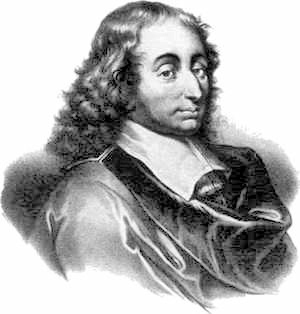
Blaise Pascal, wym. [blɛz paskal], pol. Błażej Pascal – francuski matematyk, fizyk i filozof religii. Był niezwykle uzdolnionym dzieckiem, wyedukowanym przez ojca. Jego wczesne dzieła powstawały spontanicznie, lecz w istotny sposób przyczyniły się do rozwoju nauki. Miał on znaczący wkład w konstrukcję mechanicznych kalkulatorów i mechanikę płynów; sprecyzował także pojęcia ciśnienia i próżni, uogólniając prace Torricellego. W swoich opracowaniach bronił metody naukowej.
Pascal był przede wszystkim matematykiem, wniósł znaczący wkład w powstanie i rozwój dwóch nowych działów wiedzy. Już jako szesnastolatek napisał pracę obejmującą zagadnienia geometrii rzutowej, później zaś wraz z Pierre'em de Fermatem rozważał kwestie teorii prawdopodobieństwa, wywierając tym samym niemały wpływ na rozwój nowoczesnej ekonomii i nauk społecznych.
W następstwie doświadczonego przezeń w roku 1654 mistycznego przeżycia porzucił działalność naukową, poświęcając się filozofii i teologii. Z tego okresu jego życia pochodzą dwa najbardziej znane dzieła Pascala: Prowincjałki i Myśli. Przez całe życie borykał się z problemami zdrowotnymi; zmarł w wieku 39 lat.
Jego Pensées z uwagami Voltaire'a umieszczone zostały w index librorum prohibitorum dekretem z 1789 roku. Wikipedia
„Jedna kropla miłości jest więcej warta niż ocean dobrych chęci i rozumu.”
Wariant: Kropla miłości znaczy więcej niż ocean rozumu.
Źródło: Irena Tomala, Liryki Arizońskiej Dziewczyny, wyd. BookBrewer
Źródło: Leksykon złotych myśli, wyboru dokonał Krzysztof Nowak, Warszawa 1998.
„Serce ma swoje racje, których rozum nie zna.”
Le cœur a ses raisons que la raison ne connaît pas. (fr.)
Myśli (1660)
Źródło: op. cit., s. 100.
Źródło: Marta Żurawiecka, Z księdzem Twardowskim 2014, Wyd. Diecezjalne i Drukarnia w Sandomierzu, Sandomierz 2013, s. 98.
„Myśl stanowi wielkość człowieka.”
Myśli (1660)
Źródło: Myśli, wyd. Księg. św. Wojciecha, Poznań 1921, s. 122, tłum. Tadeusz Boy-Żeleński.
Blaise Pascal książka Prowincjałki
fragment polemiki z jezuitami.
Źródło: Prowincjałki, przeł. Tadeusz Boy-Żeleński
„List ten jest dłuższy jedynie dzięki temu, iż nie miałem czasu napisać go krócej.”
Blaise Pascal książka Prowincjałki
Je n'ai fait celle-ci plus longue que parce que je n'ai pas eu le loisir de la faire plus courte. (fr.)
Źródło: Lettres provinciales, List XVI
Blaise Pascal książka Prowincjałki
Źródło: Prowincjałki, Czwarty list do przyjaciela z prowincji, Inst. Wyd. »Bibljoteka Polska«, Warszawa 1921, s. 57, tłum. T. Boy-Żeleński.
Discourses on the Condition of the Great
Kontekst: What is it, in your opinion, to be a great nobleman? It is to be master of several objects that men covet, and thus to be able to satisfy the wants and the desires of many. It is these wants and these desires that attract them towards you, and that make them submit to you: were it not for these, they would not even look at you; but they hope, by these services... to obtain from you some part of the good which they desire, and of which they see that you have the disposal.
“The source of the errors of these two sects, is in not having known”
Conversation on Epictetus and Montaigne
Kontekst: The source of the errors of these two sects, is in not having known that the state of man at the present time differs from that of his creation; so that the one, remarking some traces of his first greatness and being ignorant of his corruption, has treated nature as sound and without need of redemption, which leads him to the height of pride; whilst the other, feeling the present wretchedness and being ignorant of the original dignity, treats nature as necessarily infirm and irreparable, which precipitates it into despair of arriving at real good, and thence into extreme laxity.
The Art of Persuasion
Kontekst: It is necessary to have regard to the person whom we wish to persuade, of whom we must know the mind and the heart, what principles he acknowledges, what things he loves; and then observe in the thing in question what affinity it has with the acknowledged principles, or with the objects so delightful by the pleasure which they give him.
“Logic has borrowed, perhaps, the rules of geometry, without comprehending their force”
The Art of Persuasion
Kontekst: Logic has borrowed, perhaps, the rules of geometry, without comprehending their force... it does not thence follow that they have entered into the spirit of geometry, and I should be greatly averse... to placing them on a level with that science that teaches the true method of directing reason.
“It is not among extraordinary and fantastic things that excellence is to be found”
The Art of Persuasion
Kontekst: It is not among extraordinary and fantastic things that excellence is to be found, of whatever kind it may be. We rise to attain it and become removed from it: it is oftenest necessary to stoop for it.
see St. Augustine, Civitate Dei, 1. XI, c. xxvi
The Art of Persuasion
Kontekst: I would inquire of reasonable persons whether this principle: Matter is naturally wholly incapable of thought, and this other: I think, therefore I am, are in fact the same in the mind of Descartes, and in that of St. Augustine, who said the same thing twelve hundred years before.... I am far from affirming that Descartes is not the real author of it, even if he may have learned it only in reading this distinguished saint; for I know how much difference there is between writing a word by chance without making a longer and more extended reflection on it, and perceiving in this word an admirable series of conclusions, which prove the distinction between material and spiritual natures, and making of it a firm and sustained principle of a complete metaphysical system, as Descartes has pretended to do.... it is on this supposition that I say that this expression is as different in his writings from the saying in others who have said it by chance, as in a man full of life and strength, from a corpse.
The Art of Persuasion
“A few rules include all that is necessary for the perfection of”
The Art of Persuasion
Kontekst: A few rules include all that is necessary for the perfection of the definitions, the axioms, and the demonstrations, and consequently of the entire method of the geometrical proofs of the art of persuading.
“All men are almost led to believe not of proof, but by attraction.”
The Art of Persuasion
Kontekst: All men are almost led to believe not of proof, but by attraction. This way is base, ignoble, and irrelevant; every one therefore disavows it. Each one professes to believe and even to love nothing but what he knows to be worthy of belief and love.
De l'Art de persuader ["On the Art of Persuasion"], written 1658; published posthumously.
Źródło: De l'art de persuader
“Il n'est pas certain que tout soit incertain.”
Źródło: Pascal's Pensees
Blaise Pascal Myśli
Wariant: People are generally better persuaded by the reasons which they have themselves discovered than by those which have come into the mind of others.
Źródło: Pensees
“It is a natural illness of man to think that he possesses the truth directly…”
C'est une maladie naturelle à l'homme de croire qu'il possède la vérité directement…
Section I
Variant translation: It is man's natural sickness to believe that he possesses the Truth.
On the Spirit of Geometry
“To ridicule philosophy is really to philosophize.”
Blaise Pascal Myśli
Wariant: To make light of philosophy is to be a true philosopher.
Źródło: Pensées
“Little things comfort us because little things distress us.”
Źródło: Pensées and Other Writings


